White Bronze Headstones Guide
White Bronze headstones, often called Zinker monuments or Zinkies, are among the most unusual historic cemetery monuments found in American cemeteries. Despite the name, they are not bronze. They are hollow cast zinc monuments marketed as “White Bronze” by the Monumental Bronze Company of Bridgeport, Connecticut and related regional companies during the late nineteenth and early twentieth centuries.
This guide explains what White Bronze monuments are, how they were manufactured, how families ordered them through catalogs and traveling salesmen, how to identify them in cemeteries, what their symbols mean, and how they should be documented and preserved.
Gravestone Revival is building a local field archive of White Bronze monuments documented in Saratoga, Fulton, and Montgomery Counties, New York, including examples at Prospect Hill Cemetery, West Charlton Cemetery, Greenridge Cemetery, and North Milton Cemetery.
Research Status
This page is a growing White Bronze monument research archive. Gravestone Revival will continue adding local examples, original catalog pages, antique advertisements, symbol comparisons, and field documentation as more monuments are photographed throughout Saratoga, Fulton, and Montgomery Counties, New York.
- Documented local White Bronze monuments: 4
- Documented examples: Funston family monument, Wilkie family monument, Smith family monument, and Lockwood family monument
- Documented cemeteries: Prospect Hill Cemetery, West Charlton Cemetery, Greenridge Cemetery, and North Milton Cemetery
- Catalog material: Monumental Bronze Company catalog cover and catalog pages being archived
- Original advertisements: Three 1904 Monumental Bronze Company advertisements documented
- Research area: Saratoga, Fulton, and Montgomery Counties, New York
What Are White Bronze Headstones?
White Bronze headstones are historic cemetery monuments made from cast zinc. They were promoted as “White Bronze” because the name sounded more elegant and permanent than zinc, but the material itself is not true bronze. These monuments usually have a distinctive blue-gray color, raised lettering, crisp cast decoration, visible seams, and hollow construction.
Unlike marble or granite monuments, White Bronze monuments were not carved from stone. They were manufactured from cast metal sections. Family names, dates, epitaphs, religious symbols, floral designs, portrait panels, anchors, wreaths, broken chains, clasped hands, doves, crowns, wheat sheaves, military emblems, roses, and other ornaments could be selected from catalogs and incorporated into the finished monument.
Many White Bronze monuments remain surprisingly legible after more than a century because the lettering and decoration were cast in raised relief rather than cut into a softer stone surface. That durability is one reason they are so interesting to genealogy researchers, cemetery historians, preservationists, and families today.
Common Names for White Bronze Monuments
These monuments are known by several names. When researching cemetery records, old advertisements, collector references, or family history, it helps to understand the terminology.
- White Bronze headstones
- White Bronze monuments
- Zinc headstones
- Zinc cemetery monuments
- Zinc grave markers
- Zinker monuments
- Zinkers
- Zinkies
- Monumental Bronze Company monuments
- Cast zinc cemetery memorials
The Monumental Bronze Company: 1874–1914
The White Bronze monuments most commonly found in American cemeteries were produced by the Monumental Bronze Company of Bridgeport, Connecticut. The company operated from approximately 1874 to 1914, marketing cast zinc cemetery monuments under the more refined name “White Bronze.”
The company promoted its monuments as durable, attractive, customizable, and suitable for cemeteries, family plots, public memorials, and private grounds. Its catalogs offered tablets, obelisks, family monuments, columns, statues, portrait medallions, busts, bas-relief emblems, floral ornaments, religious symbols, lettering panels, and architectural details.
White Bronze monuments were not limited to Bridgeport or large cities. Through catalogs, regional companies, local agents, and traveling salesmen, Monumental Bronze products reached rural cemeteries, village cemeteries, churchyards, family burial grounds, and small-town cemeteries across the United States and Canada.
Although the monuments were promoted as “bronze,” they were actually made from zinc. The marketing name helped present the material as permanent, refined, and suitable for memorial use. Today, surviving White Bronze monuments are often called Zinkers or Zinkies by cemetery researchers, collectors, and preservationists.
The 1882 Monumental Bronze Company Catalog
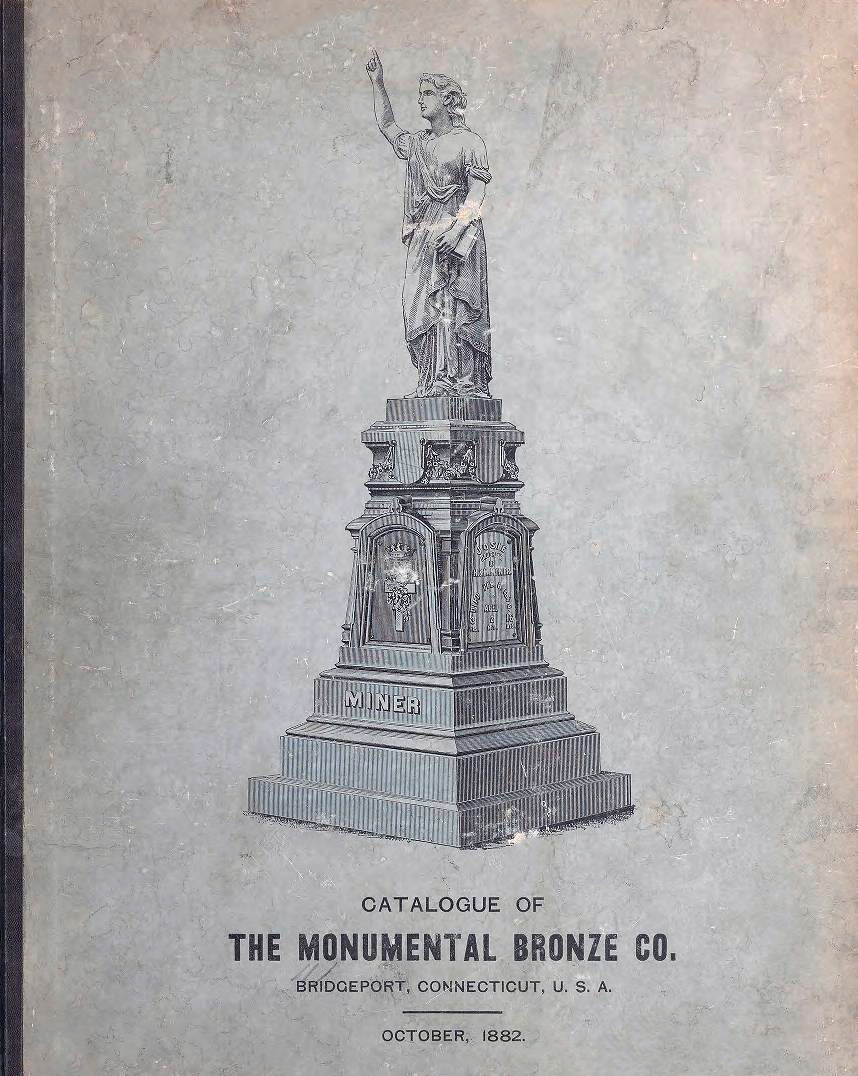
The October 1882 Catalogue of the Monumental Bronze Company is an important historical reference because it shows how White Bronze monuments were marketed during the Victorian era. Families could browse monument designs, symbolic artwork, portrait medallions, floral motifs, religious symbols, military memorials, inscription panels, and complete monument styles before placing an order.
Catalogs like this were essential to the company’s sales system. A traveling salesman could carry the catalog from town to town and use it as a portable showroom. Families did not need to travel to the Bridgeport factory to see what was available. They could select a monument style, choose symbolic decoration, approve inscription panels, and order a memorial that would later be cast, shipped, and assembled at the cemetery.
Today, original Monumental Bronze Company catalogs are valuable because many surviving White Bronze monuments can still be compared with catalog illustrations. This allows cemetery researchers to identify monument forms, decorative symbols, panel designs, and manufacturing details more accurately.
Original 1904 White Bronze Monument Advertisements
Original 1904 advertisements show how the Monumental Bronze Company sold White Bronze monuments to families, cemetery lot owners, and local monument buyers. The advertising language emphasized durability, lower cost, national delivery, artistic design, and freedom from the maintenance problems associated with marble and granite.
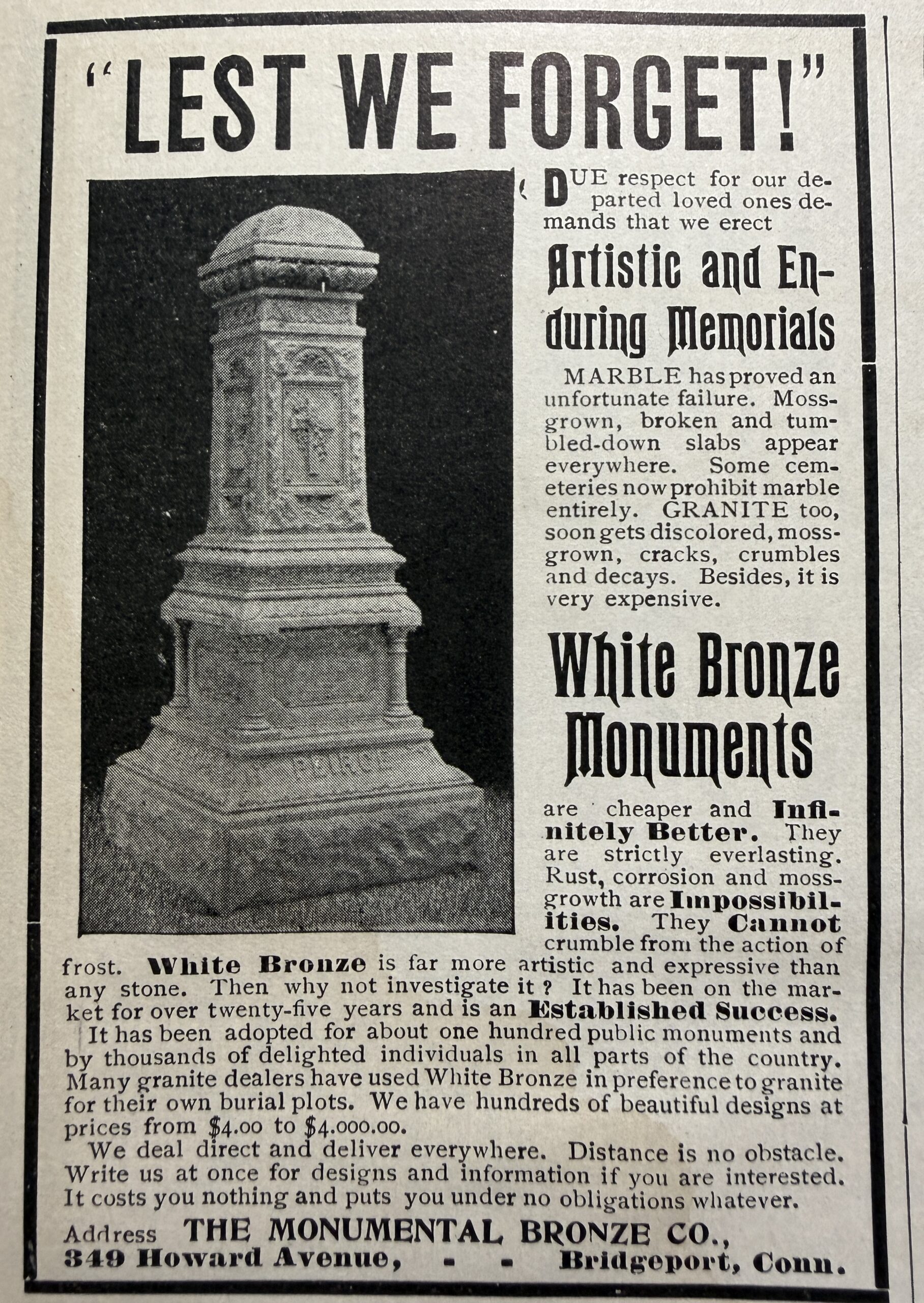
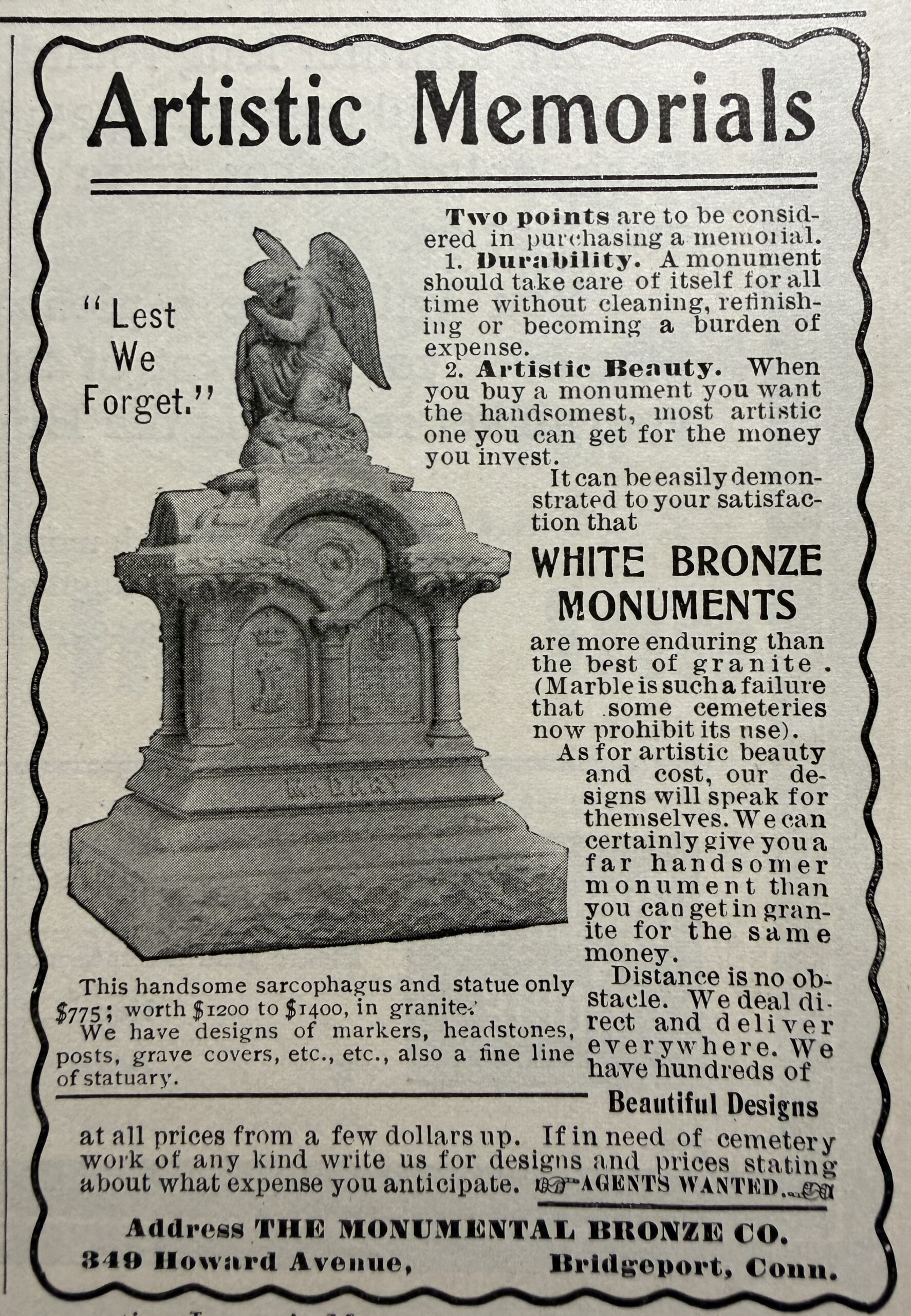
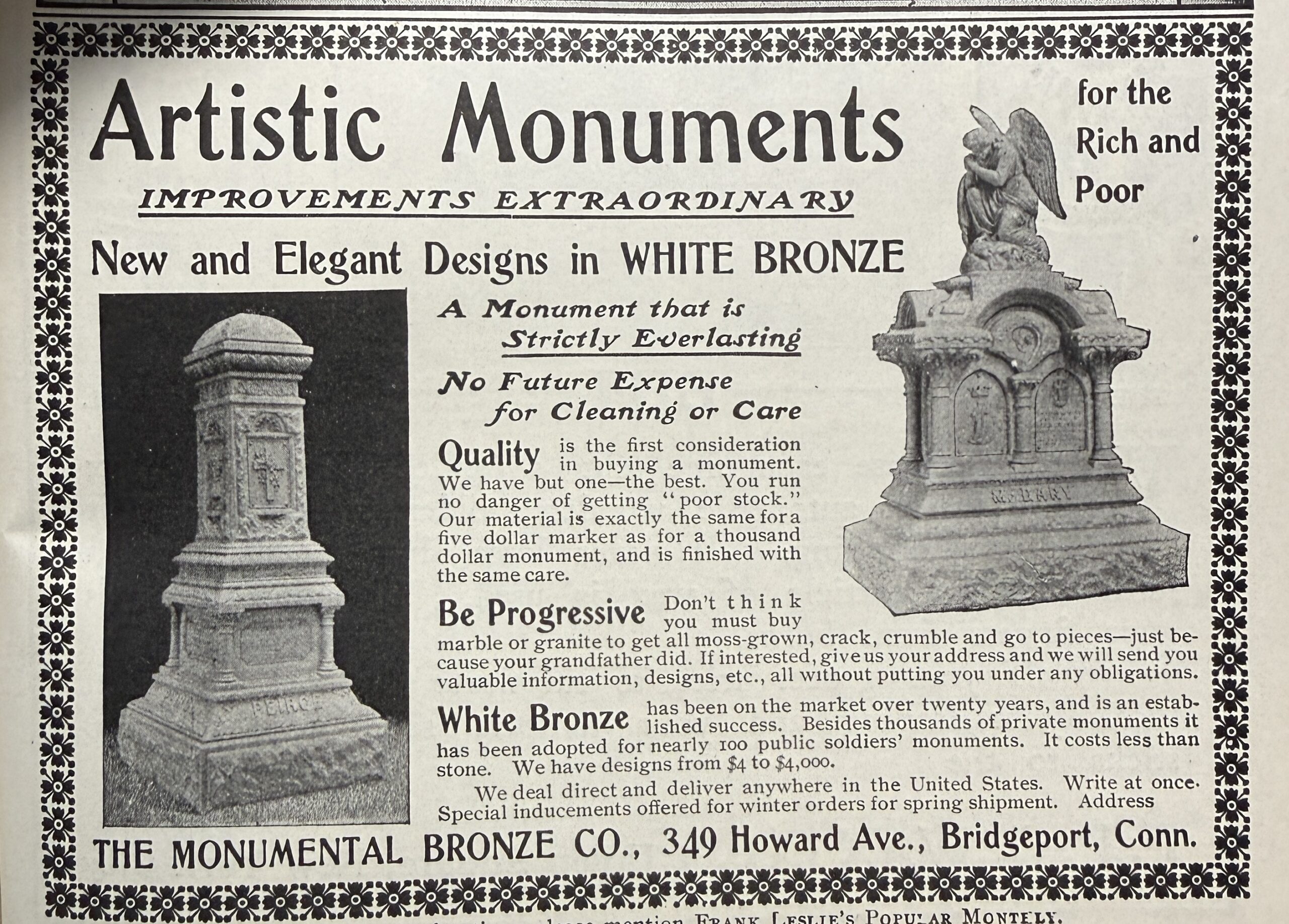
The advertisements make several claims that are important to compare with surviving monuments today. They describe White Bronze as “strictly everlasting,” “infinitely better,” less expensive than granite, resistant to moss growth, and requiring “no future expense for cleaning or care.” Surviving field examples show why the company’s lettering and cast ornament often remained legible, while also showing that seams, fasteners, panel movement, cracks, staining, and structural concerns still need careful documentation.
The ads also show how strongly the company competed against marble and granite. Rather than simply offering an alternative material, Monumental Bronze advertising often argued that marble failed, granite was expensive, and White Bronze offered a more durable and artistic memorial at a wider range of prices.
How White Bronze Monuments Were Sold
One of the most important parts of the White Bronze story is the way these monuments were sold. Families did not always visit a large monument showroom. Instead, many learned about White Bronze monuments through catalogs, agents, sample tablets, magazine advertisements, and traveling salesmen.
A salesman could arrive with an illustrated catalog and show a family dozens or hundreds of possible designs. The catalog functioned like a portable showroom. Families could compare monument shapes, select symbolic panels, choose lettering, add family names and dates, and order a memorial that would later be manufactured and shipped for installation.
The sales process was especially powerful because it allowed a family in a small village or rural community to order a monument from a national manufacturer without ever visiting the Bridgeport factory. The salesman helped translate grief, memory, symbolism, and family identity into a catalog-selected monument built from cast zinc parts.
How a Family Ordered a White Bronze Monument
The ordering process was surprisingly modern. A family could essentially build a custom memorial from catalog components.
- The salesman or agent presented the catalog. The family reviewed illustrated monument styles, symbolic panels, lettering options, and decorative elements.
- The monument form was selected. Choices could include tablets, obelisks, family monuments, columns, statues, or larger memorial designs.
- The inscription panels were customized. Names, dates, epitaphs, and family details were cast into raised panels.
- Symbols were selected. Anchors, wreaths, clasped hands, broken chains, flowers, doves, crowns, wheat sheaves, military emblems, and other motifs could be added.
- The order was sent for manufacturing. The components were cast, finished, and prepared for shipping.
- The monument was shipped in sections. Because these monuments were hollow and assembled from parts, they could be transported more easily than many large stone monuments.
- The monument was assembled at the cemetery. Panels, fasteners, bases, and vertical sections were fitted together to create the finished memorial.
Why They Were Called “White Bronze”
The name “White Bronze” was a marketing term. These monuments were made from zinc, not bronze. The name helped position the material as refined, durable, and suitable for permanent memorial use. The blue-gray surface looked different from marble, granite, sandstone, and traditional bronze plaques, which made the monuments visually distinctive in cemetery landscapes.
Over time, cemetery researchers and monument enthusiasts began using nicknames such as “Zinkers” or “Zinkies.” These names reflect the actual zinc material while also helping people distinguish these monuments from ordinary stone or bronze memorials.
How to Identify a White Bronze Monument
Once you know what to look for, White Bronze monuments are usually easy to recognize.
- Blue-gray color: White Bronze usually has a cool bluish-gray appearance.
- Raised lettering: Names, dates, and epitaphs are often raised from the panel surface.
- Hollow construction: The monument is assembled from cast sections rather than carved from solid stone.
- Visible fasteners: Panels may have screws, bolts, or decorative fasteners.
- Removable panels: Many name and inscription panels were designed as replaceable or customizable elements.
- Sharp detail: Cast symbols often remain crisp, including anchors, wreaths, flowers, chains, doves, crowns, roses, and military emblems.
- Maker marks: Some examples include marks such as Monumental Bronze Co., Bridgeport, Connecticut.
- Factory-like precision: The monument may have a more manufactured appearance than hand-carved stone.
- Sound and feel: A White Bronze monument may sound hollow if lightly tapped by hand, but monuments should never be struck, scraped, or tested aggressively.
Documented White Bronze Monuments in Saratoga County
Gravestone Revival has currently documented four White Bronze monuments in Saratoga County cemeteries. These examples show different sizes, family uses, inscription panel systems, cemetery settings, symbols, and preservation conditions.
Funston Family Monument
Cemetery: Prospect Hill Cemetery
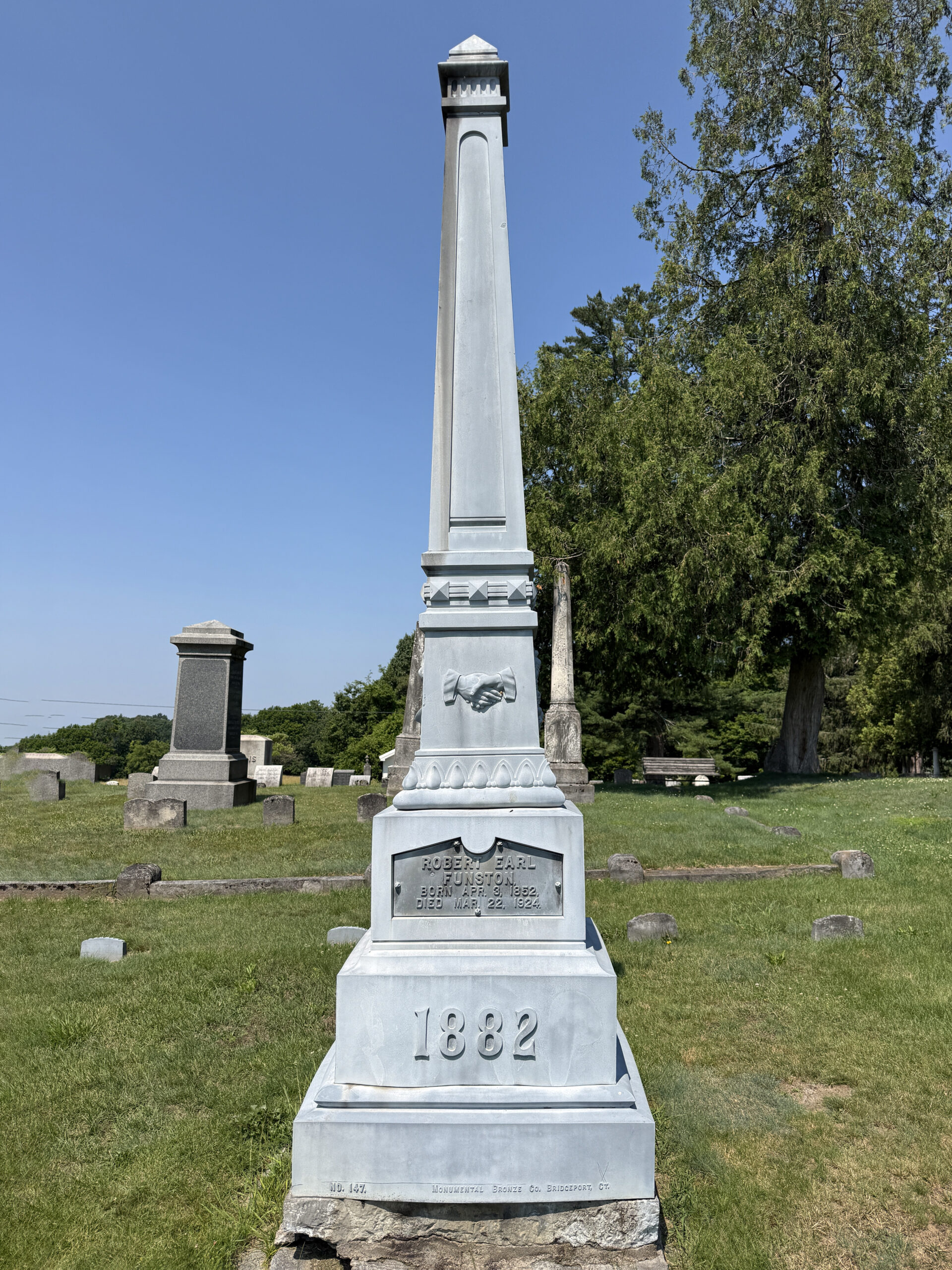
The Funston family monument is a documented White Bronze example at Prospect Hill Cemetery in Schuylerville, New York. It shows the blue-gray cast zinc surface, raised lettering, symbolic ornament, and manufactured construction associated with Zinker monuments.
Wilkie Family Monument
Cemetery: West Charlton Cemetery
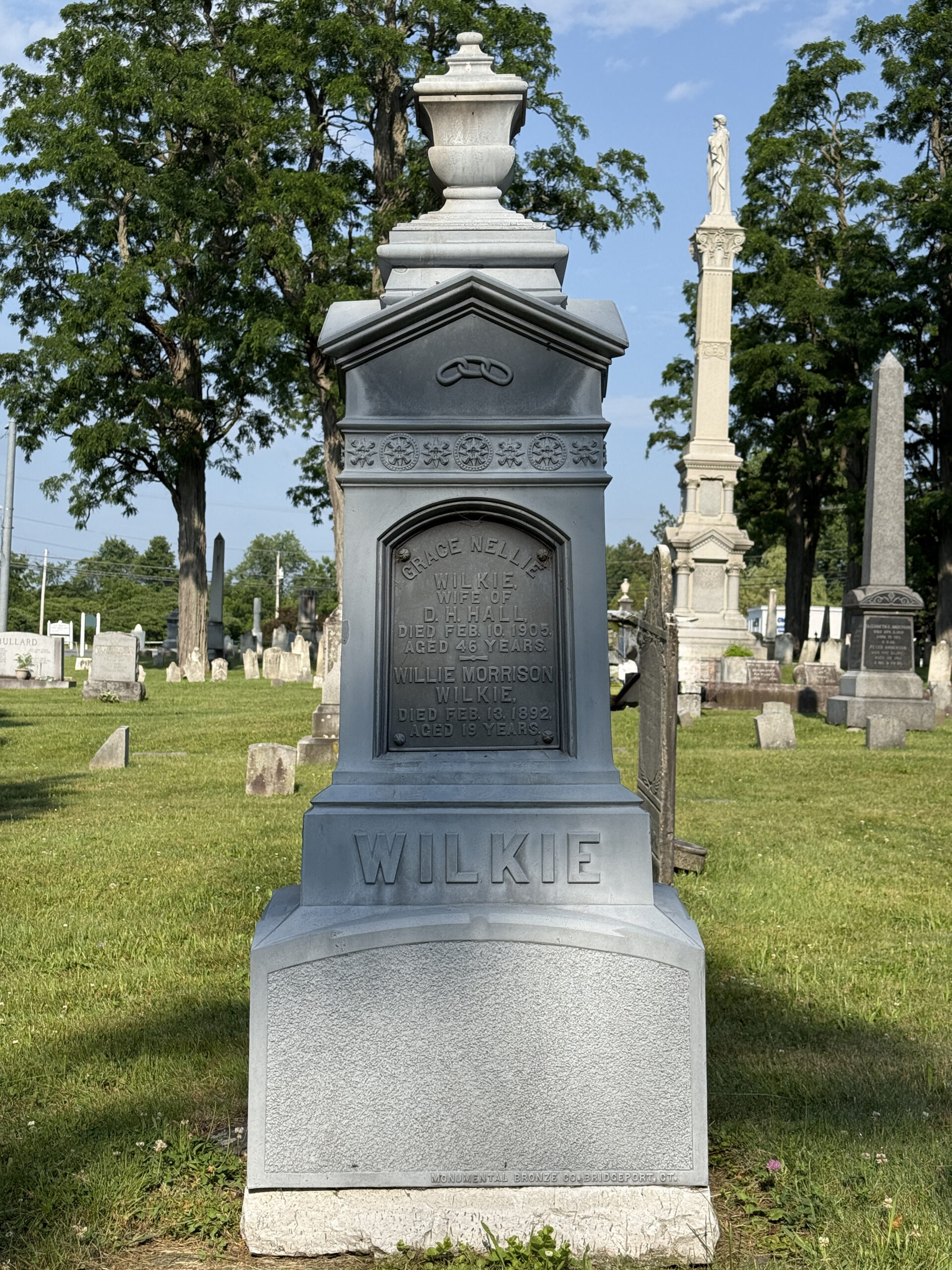
The Wilkie family monument is one of the strongest local examples of a multi-generation White Bronze family memorial. It includes removable inscription panels, raised lettering, multiple symbols, and a Monumental Bronze Company maker mark.
George A. Smith Monument
Cemetery: Greenridge Cemetery
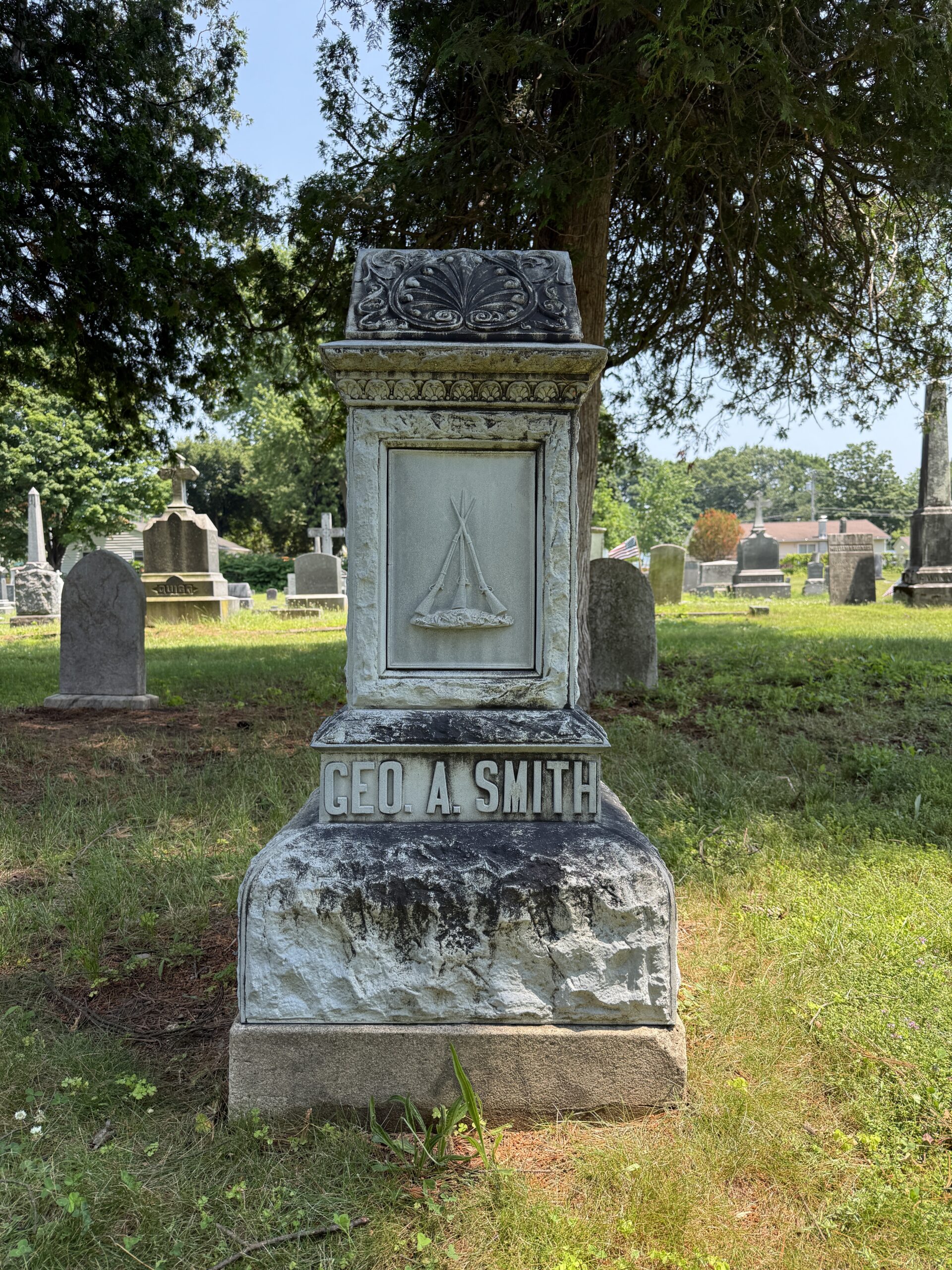
The George A. Smith monument at Greenridge Cemetery includes family inscription panels, elaborate Victorian ornament, and a raised relief panel with crossed rifles. It is an important example of symbolic decoration on a White Bronze monument.
Lockwood Family Monument
Cemetery: North Milton Cemetery
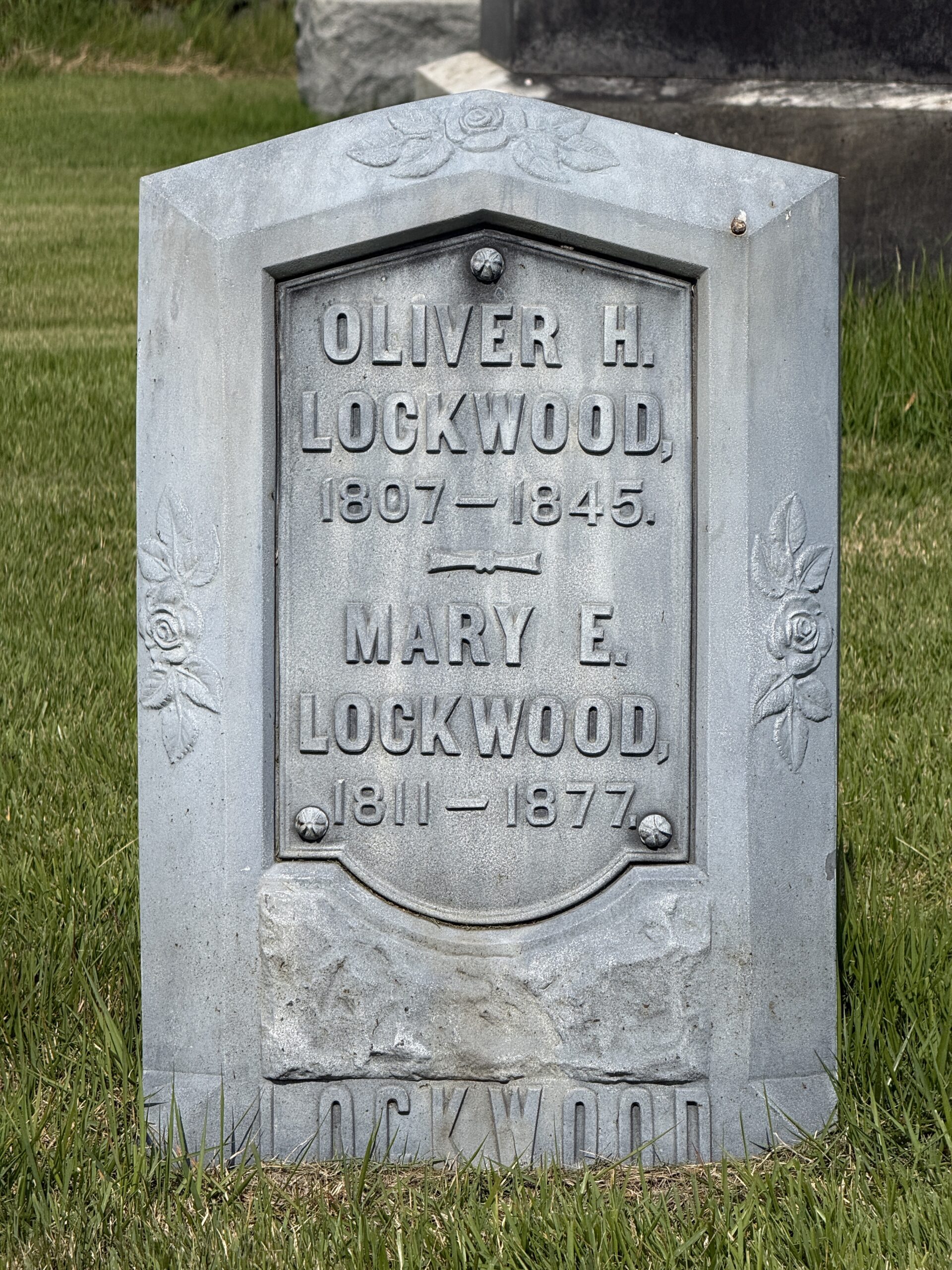
The Lockwood family monument is a smaller White Bronze family memorial at North Milton Cemetery. It shows raised lettering, floral cast ornament, visible fasteners, and a compact cast zinc monument form.
Gravestone Revival White Bronze Monument Field Archive
This local archive documents White Bronze monuments photographed by Gravestone Revival in cemeteries throughout the region. Each example adds to a larger understanding of how these monuments were ordered, customized, assembled, used by families, and preserved in cemetery landscapes.
| Archive No. | Family / Monument | Cemetery | Location | Status |
|---|---|---|---|---|
| 1 | Funston Family Monument | Prospect Hill Cemetery | Schuylerville / Victory, NY | Documented |
| 2 | Wilkie Family Monument | West Charlton Cemetery | West Charlton, NY | Documented |
| 3 | George A. Smith Monument | Greenridge Cemetery | Saratoga Springs, NY | Documented |
| 4 | Lockwood Family Monument | North Milton Cemetery | North Milton, NY | Documented |
Archive No. 1: Funston Family Monument
Cemetery: Prospect Hill Cemetery
Location: Schuylerville / Victory area, Saratoga County, New York
Family name: Funston
Material: White Bronze / cast zinc
Documentation status: Field documented by Gravestone Revival
The Funston family monument at Prospect Hill Cemetery is the first White Bronze monument documented in Gravestone Revival’s local field archive. It includes several classic White Bronze features: cast zinc construction, raised lettering, panel seams, decorative symbolism, and the distinctive blue-gray finish associated with these monuments.
Archive No. 2: Wilkie Family Monument
Cemetery: West Charlton Cemetery
Location: West Charlton, Saratoga County, New York
Family name: Wilkie
Material: White Bronze / cast zinc
Manufacturer mark: Monumental Bronze Co., Bridgeport, Ct.
The Wilkie family monument is one of the strongest local examples for explaining how White Bronze monuments functioned as multi-generation family memorials. Its panels document members of the Wilkie family across many decades, while the monument itself demonstrates the company’s removable cast panel system, raised lettering, decorative fasteners, factory ornament, and hollow zinc construction.
The Wilkie monument is especially useful because it shows how a single family memorial could remain in use for a long period of time. New names and dates could be added through cast inscription panels rather than replacing the entire monument. This is one of the major reasons White Bronze monuments are valuable to genealogy researchers and cemetery historians.
View the West Charlton Cemetery Guide →
Names Documented on the Wilkie Monument
- John Wilkie
- Elizabeth Wilkie
- John A. Wilkie
- Grace Nellie Wilkie
- Willie Morrison Wilkie
- Elbert A. Wilkie
- Sophronia J. Wilkie
- J. Snow Wilkie
- Helen Baldwin Wilkie
Archive No. 3: George A. Smith Monument
Cemetery: Greenridge Cemetery
Location: Saratoga Springs, Saratoga County, New York
Family name: Smith
Material: White Bronze / cast zinc
Documentation status: Field documented by Gravestone Revival
The George A. Smith monument at Greenridge Cemetery is an important local example because it combines family memorial panels with a crossed rifles relief. This monument shows how White Bronze memorials could incorporate personal identity, family relationships, and symbolic imagery into a manufactured monument form.
The monument documents several members of the Smith family, including George A. Smith, Carrie Simpson Smith, Alice Smith, and Howard A. Smith. The crossed rifles panel may suggest military association or commemorative identity, but that interpretation should be confirmed through cemetery records, veteran records, or family history before being stated as fact.
Archive No. 4: Lockwood Family Monument
Cemetery: North Milton Cemetery
Location: North Milton, Saratoga County, New York
Family name: Lockwood
Material: White Bronze / cast zinc
Documentation status: Field documented by Gravestone Revival
The Lockwood family monument at North Milton Cemetery is a smaller White Bronze family memorial with raised lettering and floral ornament. It records Oliver H. Lockwood, Mary E. Lockwood, Lyman G. Lockwood, and Oliver G. Lockwood, preserving family relationships and dates in a compact cast zinc form.
This monument is especially useful for comparison because it differs from the taller family monuments documented at Prospect Hill, West Charlton, and Greenridge. It shows that White Bronze monuments were available in many sizes and price ranges, from large family monuments to smaller cemetery markers.
Symbols Documented on Local White Bronze Monuments
White Bronze monuments are especially useful for symbolism research because the decorative elements were cast in relief and often remain legible long after softer stone details have weathered away. The monuments documented by Gravestone Revival show a growing collection of Victorian cemetery symbols and factory-selected memorial emblems. For a broader guide to cemetery imagery, see Headstone Symbols and Meanings.
Anchor
The anchor commonly represents hope, faith, steadfastness, and safe passage. On White Bronze monuments, an anchor was not carved by hand into stone. It was selected as a cast decorative emblem and produced as part of the manufactured monument system.
Broken Chain and Linked Chain
Chain symbolism can represent connection, family bonds, earthly ties, and separation. A broken chain often reflects a bond interrupted by death, while linked chain imagery may emphasize continuity, family connection, or fraternal symbolism depending on the full monument context.
Dove
A dove commonly represents peace, the soul, purity, innocence, or spiritual passage. On the Wilkie monument, the dove appears as a raised cast emblem, showing how delicate symbolic forms could be incorporated into a zinc monument and remain visible for generations.
Crown
A crown can represent victory, honor, eternal reward, or triumph over death. In Victorian cemetery symbolism, a crown may also reflect Christian ideas of heavenly reward or spiritual victory.
Wheat Sheaf
A wheat sheaf often represents a full life, harvest, maturity, and the gathering of life at death. On White Bronze monuments, wheat could be chosen as a catalog ornament and cast as a raised decorative panel.
Roses and Floral Ornament
Roses and floral ornament often represent love, beauty, memory, mourning, and the fragility of life. The Lockwood monument at North Milton Cemetery shows rose and leaf ornament cast into the monument form.
Crossed Rifles
Crossed rifles are commonly associated with military service, commemoration, or veteran identity. The Smith family monument at Greenridge Cemetery includes a crossed rifles relief, making it an important candidate for additional record research before any specific military conclusion is stated.
Removable Panels and Multi-Generation Family Memorials
One of the most important features of many White Bronze monuments is the removable inscription panel system. Instead of carving a new inscription into stone, families could order cast panels with names, dates, relationships, and epitaphs. These panels were mounted into the monument body with visible fasteners.
The Wilkie monument at West Charlton Cemetery is a strong local example. It documents multiple family members across a long span of time, showing how a White Bronze family memorial could remain in active family use for decades. The raised lettering, screws, panel borders, and cast construction help explain how the monument was designed to receive customized memorial panels.
This construction method is one reason White Bronze monuments are so valuable for Family Memorial Documentation. A single monument may preserve several generations of names and relationships in a clear, readable form.
Preservation Notes for White Bronze Monuments
White Bronze monuments should not be treated like marble, granite, sandstone, or bronze plaques. They are hollow cast zinc structures with seams, panels, fasteners, and manufactured components. Preservation decisions should begin with documentation, not aggressive cleaning.
- Do not pressure wash White Bronze monuments.
- Do not use harsh chemicals.
- Do not use wire brushes, abrasive pads, or metal scrapers.
- Do not wax, oil, or coat the surface without professional preservation guidance.
- Do not remove panels casually.
- Do not assume a White Bronze monument should be cleaned the same way as stone.
- Document seams, fasteners, panels, base contact, cracks, openings, distortion, staining, biological growth, and missing parts before any work is considered.
In many cases, the most valuable first step is a written Cemetery Condition Report with detailed photographs. This allows families to understand the monument’s current condition before deciding whether cleaning, stabilization, repair consultation, or monitoring is appropriate.
For related preservation guidance, see Pressure Washing Gravestones: Hidden Damage Explained, DIY Gravestone Care, and Headstone Repair & Gravestone Stabilization.
What the Local Field Examples Reveal
The White Bronze monuments documented by Gravestone Revival show why these memorials deserve careful attention. They are durable, readable, and visually distinctive, but they are not maintenance-free or indestructible.
- Legibility: Raised cast lettering often remains readable long after many stone inscriptions become difficult to see.
- Symbol preservation: Cast symbols such as doves, crowns, wheat, roses, chains, rifles, anchors, and wreaths can remain sharply defined.
- Panel construction: Many family monuments used removable inscription panels secured by visible fasteners.
- Family history value: A single monument may document parents, spouses, children, and later generations.
- Surface conditions: White Bronze monuments may show staining, biological growth, oxidation, streaking, and dirt accumulation.
- Structural concerns: Caps, seams, bases, panels, fasteners, and cracks should be documented before any preservation action.
- Catalog evidence: Surviving monuments match the marketing system shown in historic catalogs and advertisements.
White Bronze vs. Stone and Bronze Plaques
White Bronze monuments are often confused with stone, painted metal, or traditional bronze plaques, but they are different in material, construction, and preservation needs.
| Memorial Type | Material | Common Features | Preservation Concern |
|---|---|---|---|
| White Bronze | Cast zinc | Blue-gray color, hollow sections, raised lettering, bolted panels | Panels, seams, fasteners, distortion, improper cleaning |
| Marble | Natural stone | Soft white or gray surface, carved inscriptions | Erosion, sugaring, biological growth, loss of readability |
| Granite | Natural stone | Polished or rough surface, durable inscriptions | Biological growth, staining, joint issues, settlement |
| Bronze Plaque | Bronze alloy | Flat plaque mounted to stone or concrete | Oxidation, staining, mounting issues, wax or coating problems |
Frequently Asked Questions About White Bronze Headstones
Are White Bronze headstones actually bronze?
No. White Bronze monuments are made from cast zinc. “White Bronze” was the marketing name used to make the material sound refined, durable, and suitable for cemetery memorials.
Why are they called Zinkers?
The nickname “Zinker” comes from the zinc material. Cemetery researchers, collectors, and preservationists often use the term to describe White Bronze monuments.
How can I tell if a monument is White Bronze?
Look for a blue-gray color, raised cast lettering, visible panel seams, screws or fasteners, hollow construction, crisp decorative detail, and possible manufacturer marks such as Monumental Bronze Co. Bridgeport, Connecticut.
Can White Bronze monuments be cleaned?
Sometimes, but they should be approached cautiously. Documentation should come first. Do not pressure wash, scrape, wire brush, or treat them like stone. The monument’s panels, fasteners, seams, and structural condition should be reviewed before any cleaning decision.
Do White Bronze monuments need documentation?
Yes. Even when they appear stable, White Bronze monuments should be documented carefully. Photographs of all sides, seams, fasteners, inscription panels, symbols, maker marks, base contact, and visible condition issues can help families and cemeteries make better preservation decisions.
Related Gravestone Revival Resources
- Prospect Hill Cemetery Schuylerville NY Guide
- West Charlton Cemetery Charlton NY Guide
- Greenridge Cemetery Saratoga Springs NY Guide
- North Milton Cemetery Milton NY Guide
- Saratoga County Cemetery Guide
- Saratoga County Cemetery Directory
- Cemetery Condition Reports
- Family Memorial Documentation
- Professional Gravestone Cleaning
- Headstone Repair & Gravestone Stabilization
- Headstone Symbols and Meanings
- Pressure Washing Gravestones: Hidden Damage Explained
- DIY Gravestone Care
- Knowledge Center
Need a Historic Cemetery Monument Documented?
Gravestone Revival provides cemetery documentation, condition reports, and preservation-focused cemetery care throughout Saratoga, Fulton, and Montgomery Counties, New York. Historic and unusual monuments such as White Bronze Zinkers should be documented carefully before any preservation decision is made.
If your family has a White Bronze monument, historic family monument, veteran marker, or unusual cemetery memorial that needs current photographs, visible condition notes, or preservation guidance, include the cemetery name, family surname, location details, and any existing photos when requesting help.